If your board still uses rewireable fuses, trips for no clear reason, has no RCD protection, or you are buying, selling or renting an older home, it may be time for a new consumer unit. A modern board with RCD or RCBO protection costs £700 to £1,000, takes two to four hours to fit, and comes with a certificate.
Your consumer unit, or fuse board, quietly does one of the most important jobs in your home. It distributes power to every circuit and, on a modern board, cuts that power in a fraction of a second if a dangerous fault develops. Older boards often cannot do that last part, which is why an upgrade is one of the most worthwhile safety improvements you can make. Here are the signs worth watching for.
What a Consumer Unit Does
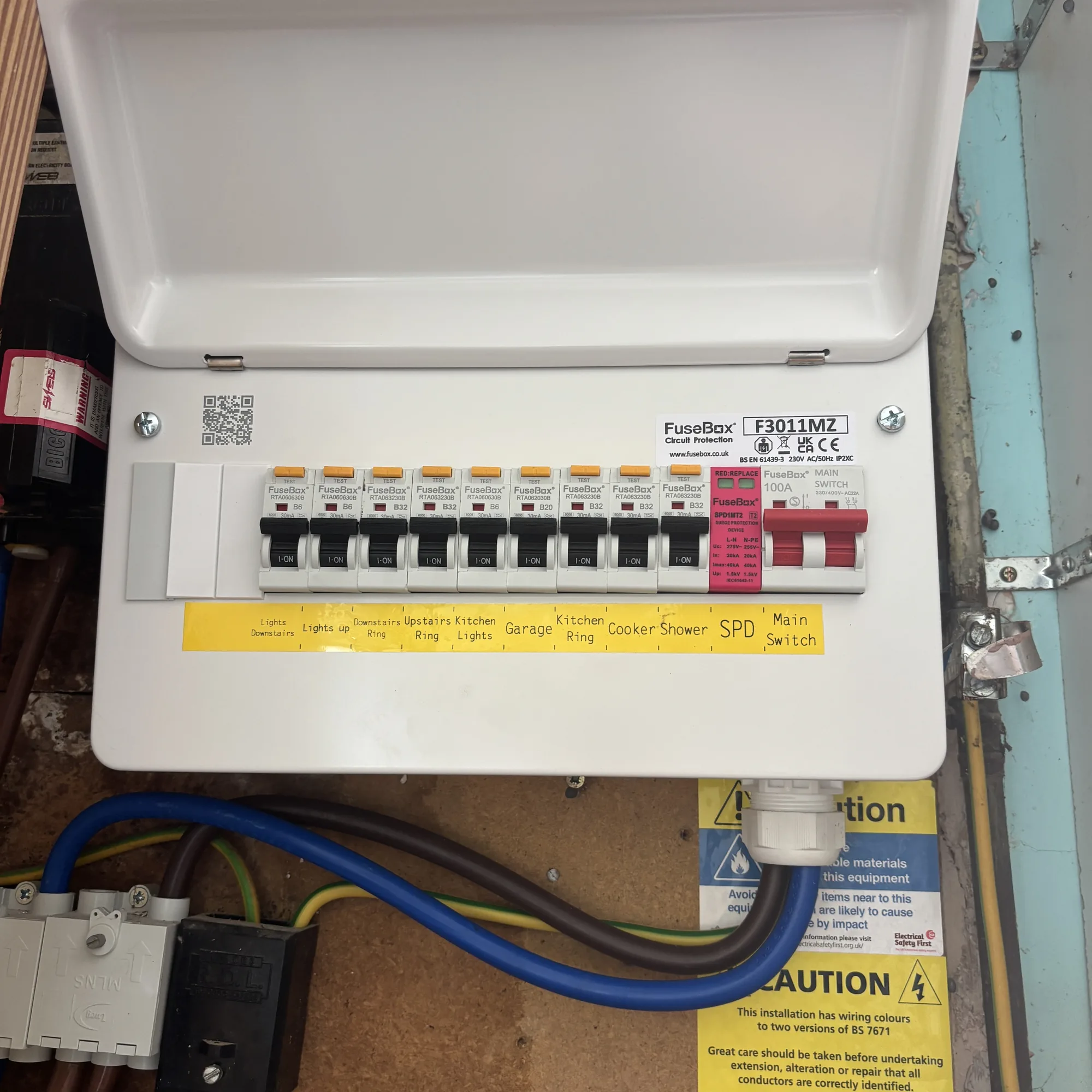
The consumer unit is where your incoming supply is split into the individual circuits that feed your lights, sockets, cooker, shower and so on. Each circuit has its own protective device, and a modern board adds RCD or RCBO protection that trips quickly if there is an earth fault, greatly reducing the risk of electric shock or fire.
Five Signs to Watch For
- Rewireable fuses: If your board still uses the old ceramic fuse holders with wire in them, it is a good few decades out of date and offers none of the protection a modern board does.
- No RCD protection: If nothing on your board looks like a test button, you probably have no RCD protection, which current regulations expect on most circuits.
- Nuisance tripping: A board that trips for no clear reason, or will not reset cleanly, is often trying to tell you something is wrong.
- A hot, discoloured or buzzing board: Any warmth, scorching or buzzing at the board should be looked at by an electrician promptly.
- Buying, selling or renting: An older board frequently shows up on a homebuyer survey or a landlord inspection, and upgrading it clears the point cleanly.
Not Sure About Your Fuse Board?
Call Stewart on 07798 747302 for honest advice on whether your consumer unit needs upgrading, across Tiverton, Exeter and Mid Devon.
Call for a Free QuoteWhat a New Board Changes
Swapping an old board for a modern consumer unit brings a few clear improvements.
- Faster fault protection: RCD or RCBO devices cut the power in a fraction of a second on an earth fault, protecting people as well as the installation.
- Circuit-by-circuit control: With RCBOs, a fault on one circuit no longer knocks out half the house. Only the affected circuit trips.
- Clear labelling: Every circuit is identified, so you and any future electrician know exactly what is what.
- A clean bill of health: Before connecting the new board we assess the existing wiring, so you know the condition of what it feeds.
Cost and Time
A consumer unit upgrade with SJ Electrical Services typically costs between £700 and £1,000, and most replacements take between two and four hours. Your power is only off for part of the day, and we plan the work so it causes as little disruption as possible. The exact price depends on the number of circuits and the condition of the existing installation, and you get a clear fixed quote before we start.
Certificates and Compliance
Replacing a consumer unit is notifiable work, so it has to be certified.
- Electrical Installation Certificate: You receive an EIC confirming the new board and circuits have been installed and tested correctly.
- Building Control notification: As a NAPIT registered electrician, Stewart notifies Building Control on your behalf where required.
- Paperwork that travels: You are left with documentation you can hand straight to a buyer, landlord or insurer.
Always use a registered electrician for a consumer unit upgrade. SJ Electrical Services is NAPIT registered, and every board we fit is fully tested and certified.
Frequently Asked Questions
An RCD has a small test button on the front. If your board has no test button anywhere, it most likely has no RCD protection. If you are unsure, we are happy to take a quick look and tell you where you stand.
Most consumer unit replacements take two to four hours, so your power is only off for part of the day. We will let you know the expected timing when we book the work so you can plan around it.
An RCD protects a group of circuits, so a fault trips them all. An RCBO protects a single circuit on its own, so a fault only takes out that one circuit. Boards with individual RCBOs are more convenient and are what we usually recommend.
Yes. Before connecting a new board we assess the condition of the existing installation, so we know what we are wiring into. If we find anything that needs attention, we will tell you clearly and never push work that is not necessary.